
Personal alarms provide essential safety support for older Australians and people with disabilities, helping you maintain independence while staying connected to help when you need it. Several government-subsidised programs can make these devices more accessible and affordable.
This guide walks you through your funding options, so you and your loved ones can find the right support for your unique situation.
My Aged Care Packages
A My Aged Care Package provides government-funded services and support to help older Australians maintain their independence at home. These packages offer practical assistance with everyday living, including equipment such as walking frames or personal alarms, along with personal care, home help, transport, social activities, and meals. This flexible support is designed around your needs, helping you live safely in the home you love.
My Aged Care offers two main programs, depending on your level of need. The Commonwealth Home Support Program (CHSP) provides entry-level care for those who need some assistance but can largely manage independently. For more complex care needs, the Support at Home Program offers comprehensive support to help you stay in your own home longer.
Types of My Aged Care Support
Depending on your My Aged Care package, you can access different types of support:
- Care in your home – Home care (also called in-home support) helps with domestic tasks, personal care, and social activities, allowing you to continue living independently.
- Short-term care – Respite or after-hospital support provides assistance for a few days or weeks while you recover from illness or injury, or while your regular carer takes a break. This type of care is usually provided in an aged care home.
- Residential care in aged care homes – For those who need more comprehensive assistance, residential care offers accommodation, 24-hour supervision, personal care, and access to health services.
Who Is Eligible for Aged Care Services?
Eligibility for aged care services depends on your health, how you’re managing at home, and your current support arrangements. You may be eligible if you’ve recently noticed changes in your ability to do things or remember things, been diagnosed with a medical condition or experienced reduced mobility, had changes in your family care arrangements, experienced a fall or hospital admission, or are 65 years or older (50 years or older for Aboriginal or Torres Strait Islander people).
How to Access Aged Care Services
An assessment process will evaluate your individual circumstances to determine your eligibility. You can check your eligibility through the My Aged Care website.
For assistance, call My Aged Care on 1800 200 422. The team can answer your questions and help you through the process. If needed, a friend or family member can speak on your behalf as your nominated representative.
Related Reading: What is a My Aged Care Package?
Commonwealth Home Support Program (CHSP)
The Commonwealth Home Support Program (CHSP) is an Australian Government initiative that helps older Australians live independently and safely in their own homes. As the most accessible government-funded aged care program, CHSP provides essential support services including personal emergency alarms and monitoring systems. The Australian Government partners with around 1,400 CHSP providers—most of which are not-for-profit organisations—to deliver these services at subsidised rates. Participants pay a partially subsidised contribution fee to access services.
What Does CHSP Provide?
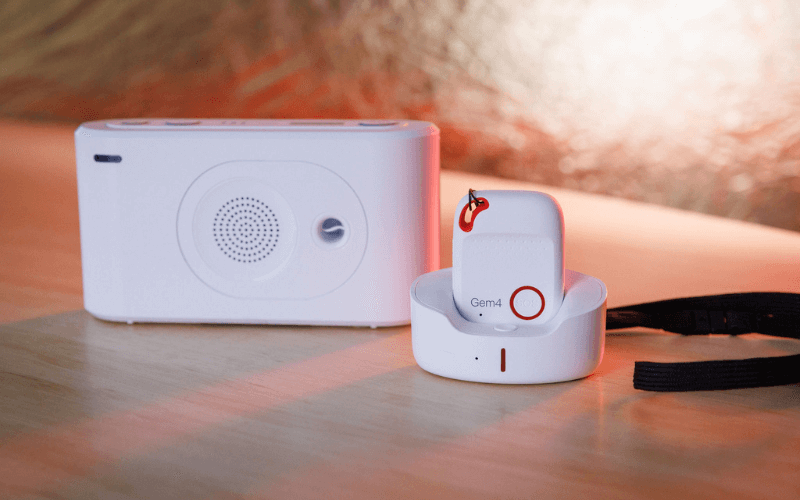
Through CHSP, you can access personal monitoring and alarm systems, including Tunstall’s Connected Care solutions. These government-funded emergency response systems provide the reassurance and safety support you need to continue living independently at home with confidence.
The COVID-19 pandemic highlighted the importance of personal alarm systems, with many older Australians discovering how Connected Care technology helped them maintain independence and safety during lockdowns and social distancing. These devices provide vital access to support and emergency assistance without leaving home.
The CHSP provides entry-level support services across several key areas:
- Personal care and health services – Assistance with daily hygiene, grooming, meals, nursing care, and therapies for movement and mobility, helping you manage health conditions while maximising your independence
- Respite services – Temporary relief through day and overnight breaks, supporting both you and your carers when you need a break
- Home maintenance and modifications – Services to keep your home safe and liveable, including modifications to improve safe movement, maintenance services, and assistance with cleaning and household chores
- Independence aids and equipment – Support with mobility, communication, reading, and personal care needs
- Social and community participation services – Transport to appointments and activities, social outings, groups, and visitor programs to help you stay connected with your community
Together, these services work to support you in maintaining your health, independence, and quality of life at home.
Who Is Eligible for CHSP Funding?
All CHSP clients can access funding for personal monitoring systems. Basic eligibility requirements are age-based: Australians aged 65 years and older, or Australians aged 60 years and older from a low-income background, may qualify.
While all CHSP members can access this funding, there’s an important exception for the COVID-19 personal monitoring system fund—CHSP providers cannot purchase new connected health devices for clients already using a personal monitoring system. If you’re already using a personal monitoring system, your CHSP provider will work with you to ensure your current device continues to meet your needs.
How CHSP Funding Works
The government makes these services affordable by subsidising approved service providers throughout Australia, who can then deliver care and support at reduced costs to eligible participants. Funding levels vary based on your individual circumstances and needs, and while CHSP provides subsidies, you may still need to contribute towards the cost of your personal alarm.
If you’re eligible for CHSP, you’ll contribute to your care costs based on your financial capacity. The amount depends on the type of support you receive and your chosen provider. Basic services like cleaning and meals typically cost a few dollars, while more complex services, such as home modifications, involve higher costs. Your CHSP or Home Care Package provider can give you specific information about your funding entitlements and out-of-pocket expenses.
How to Access CHSP Funding
To access CHSP funding, you must first be enrolled as a CHSP client. Search for CHSP providers that suit your needs using the My Aged Care Find a Provider tool.
Once you’re a confirmed CHSP client, speak to your service provider about accessing funding for personal monitoring systems. Your CHSP provider will work with you to find the most suitable Connected Care device for your needs. You may be asked to contribute towards the cost of your government-funded personal alarm. Your contribution amount will align with your CHSP contribution policy.
Important Note: Tunstall devices are accessed through approved CHSP or HCP providers. While Tunstall is not a direct provider, we partner with various providers to support client requirements.
CHSP and geat2GO
In addition to standard CHSP services, specialised equipment funding is available through the GEAT program.
Goods, Equipment and Assistive Technology (GEAT) is a specialized funding category within CHSP that helps older Australians access essential assistive technology to stay safe and independent at home. This program enables service providers to deliver supports such as personal alarms, mobility equipment, and daily living aids that make everyday life easier and safer.
Who Is Eligible for GEAT and geat2GO?
GEAT services are designed for older Australians who want to maintain their independence with some practical support. GEAT may be suitable if you can live independently with some assistance but don’t yet require intensive aged care services.
geat2GO operates as a national GEAT provider within CHSP, filling service gaps when local providers cannot meet demand. Your allied health professional or assessor will first explore local GEAT providers in your Aged Care Planning Region, and can refer you to geat2GO if those providers are unable to meet your needs.
How to Access geat2GO
Your allied health professional or assessor can refer you to geat2GO if local GEAT providers cannot meet your needs. The Tunstall Gem4 personal alarm is now available through geat2GO, offering reliable Connected Care technology to help individuals maintain independence and safety at home. This 4G mobile personal alarm system works both indoors and outdoors.
As an approved geat2GO provider, Tunstall Healthcare makes our assistive technology solutions accessible to older Australians who need them. We work closely with assessors and allied health professionals throughout the referral process to ensure you receive the right personal alarm for your specific needs and circumstances.
Personal alarms requested through geat2GO typically arrive within one to two weeks. If you’re an allied health professional looking to prescribe Tunstall personal alarms through geat2GO, contact our team to discuss your clients’ needs.
Support at Home Program
The Support at Home program has replaced the Home Care Package program and Short-Term Restorative Care (STRC) Program, following recommendations from the Royal Commission into Aged Care Quality and Safety. This new approach creates a simpler, more equitable system that helps you stay at home longer, with streamlined access to the services and support you need.
Support at Home provides improved access to services, equipment, and home modifications to help older people remain healthy, active, and socially connected to their community. If you currently receive a home care package, you won’t need a new assessment. Your provider will contact you about transitioning to Support at Home, review your care plan with you, and ask you to sign a new agreement. This transition is designed to be straightforward, maintaining the support you already rely on.
Who Is Eligible for Support at Home?
Depending on your situation and needs, you can access ongoing support for daily living or short-term programs designed to help you regain independence, modify your home, or receive end-of-life care. Support at Home offers two main pathways:
1. Ongoing Care
You’ll be assigned one of eight classification levels based on your care needs, with funding that includes care management. This can help with everyday tasks like cleaning, meals, and getting around, or more complex care such as nursing and physiotherapy for those with higher needs. Higher classifications provide more extensive support to help you stay home longer.
2. Short-term Pathways
- Restorative Care Pathway – Short-term care that helps you regain function and independence through allied health and nursing services, potentially reducing your need for ongoing intensive support
- Assistive Technology and Home Modifications (AT-HM) Scheme – Upfront funding to make your home safer and more accessible through products, equipment, and home adjustments
- End-of-Life Pathway – Additional care to help you remain at home during your last three months of life, accessible through priority assessment even if you’re not already in the Support at Home program
What Services Does Support at Home Provide?
Support at Home offers a comprehensive range of services to help you maintain your independence, with access determined by your individual needs and assessment. Care management services are available to help plan and coordinate your support, while personal care assists with bathing, dressing, and mobility. You can also access nursing care for medical treatment, allied health services like podiatry and physiotherapy, and therapeutic services such as acupuncture and massage for your overall wellness.
Additionally, the program covers nutrition support, including dietary guidance and feeding equipment, mobility equipment like walkers and shower chairs, home modifications such as handrails and ramps for safety, and respite care to provide temporary breaks for both you and your carer.
How Support at Home Funding Works
You’ll contribute towards your services based on what’s delivered and your financial capacity. Services Australia may ask you to provide income and asset information to determine your contribution amount. Under Support at Home, you only pay for the services you actually receive, and clinical support costs are not charged—a more transparent and fair approach.
Wait times for funding after approval vary depending on your approval date, priority category (urgent, high, medium, or standard), and whether you’re approved for a short-term pathway. If you’re in a higher priority category, you’ll experience shorter wait times to access your approved funding.
How to Access Support at Home Funding
To access funded aged care services, register with My Aged Care and complete a screening process to determine the appropriate care pathway for your situation. You can start this process by:
- Calling My Aged Care on 1800 200 422
- Using the Apply for an Assessment Online form on the My Aged Care website
- Getting a referral from your GP, health professional, or hospital
- Booking an appointment with an Aged Care Specialist Officer (ACSO)
Aboriginal and Torres Strait Islander people can request during screening to have their assessment conducted by an Aboriginal and Torres Strait Islander assessment organisation, ensuring culturally appropriate support.
After screening, you’ll be referred to an aged care assessment organisation. A Triage Delegate will review your referral to determine your eligibility, the type of assessment you need (such as home support or comprehensive assessment), and your assessment priority level. An aged care assessor will then conduct your assessment.
If approved for Support at Home, you’ll receive a letter outlining your eligible services and funding. Once your funding is active, you can choose a service provider to work with. Your provider will help you create a service mix that meets your assessed needs and budget, which you can adjust at any time. You can also request a reassessment if your circumstances change.
NDIS Funding for Personal Alarms
The National Disability Insurance Scheme (NDIS) offers personalized support to eligible Australians living with intellectual, physical, sensory, and other disabilities, including assistance for their families and carers. Under the NDIS, assistive technology (AT) refers to supports directly related to your disability that are reasonable and necessary for performing essential daily activities. These supports must align with your NDIS plan goals, provide value for money, and be suitable and effective for your specific circumstances.
Who Is Eligible for NDIS Funding?
Personal alarms can often be funded through the NDIS, particularly when they support safety, fall prevention, or independent living goals. To be eligible, you must be an NDIS participant with an approved plan, and the personal alarm must be related to your disability and considered reasonable and necessary for your daily activities. It should help you work towards goals in your NDIS plan, represent value for money, and be appropriate for your needs.
What NDIS Funding Covers for Personal Alarms
As a registered NDIS provider, Tunstall Healthcare offers NDIS-funded personal alarms supported by 24/7 professional monitoring. These devices provide immediate access to help at the press of a button, whether you’re at home, in the community, or with a support worker.
Our NDIS-approved personal alarm solutions include:
- In-home alarms – Options like Lifeline Digital and NOVO provide dependable emergency response with smart home connectivity
- Mobile personal alarms – Devices such as the Gem4 and Gem5 feature GPS tracking, fall detection technology, and two-way voice calling
- Fall detection accessories – The Vibby Fall Detector offers enhanced protection through automatic alert systems
These user-friendly and discreet devices suit various living arrangements, whether you’re living independently, with family, or in supported accommodation. Our solutions help improve your safety, build your confidence, and provide peace of mind for both you and your loved ones.
How to Access NDIS Funding for Personal Alarms
To access NDIS funding for a personal alarm:
- Discuss your safety needs with your support coordinator, local area coordinator (LAC), or NDIS planner
- Ensure a personal alarm is included in your NDIS plan under assistive technology
- Contact Tunstall Healthcare as a registered NDIS provider to discuss suitable options
- Work with us to select the right personal alarm for your needs
- We’ll work with you to process the funding through your NDIS plan
Related Reading: Navigating NDIS Funding for Assistive Technologies
Personal Alert AssistanceSA (PAASA)- Personal Alarms Program
Personal Alert AssistanceSA (PAASA) is a South Australian Government initiative that helps eligible older residents access approved personal alert systems and ongoing monitoring services. These systems are particularly valuable if you’re at risk of falls or medical emergencies, helping you live safely and independently at home while staying connected to your community.
Who Is Eligible for PAASA?
To qualify for a PAASA personal alert or monitoring device, you must meet both basic requirements and clinical, functional, and social criteria.
Basic Requirements:
- Be a permanent resident of South Australia
- Be over 75 years of age
- Hold a Centrelink or Department of Veterans’ Affairs (DVA) Pensioner Concession card
- Have been assessed and approved by My Aged Care
Clinical, Functional, and Social Criteria:
- Clinical Criteria – You must be at high risk of falls, have an ongoing major medical condition, or require emergency response capability.
- Functional Criteria – You must have adequate physical and cognitive ability to wear and operate the personal alert system and be willing to activate it when necessary.
- Social Criteria – You must live alone, be alone for at least five consecutive hours four times per week, or live with someone who cannot use a phone during emergencies.
What PAASA Covers
PAASA maintains strict standards for approved devices. All approved devices must include fall detection capability and 24/7 monitoring (though non-monitored options are available), and must be 4G-compatible and equipped with SIM cards. Additional costs may apply if the supplier does not provide monitoring services.
Tunstall Healthcare is an established provider of Connected Care and Connected Health solutions with extensive experience in personal alert and monitoring systems. Our solutions support older people and individuals managing long-term health conditions to live independently with confidence.
As an approved PAASA provider, we make our personal monitoring solutions accessible to South Australians. Our approved products include 4G mobile and in-home alarms connected to our 24/7 Customer Care Centre for reliable support.
How to Access PAASA Funding
To access PAASA funding:
- Ensure you meet all eligibility requirements listed above
- Complete your My Aged Care assessment if you haven’t already
- Contact PAASA directly or speak with your aged care provider about PAASA eligibility
- Work with an approved PAASA provider like Tunstall to select the right personal alarm
- Complete the necessary paperwork with your provider
Related Reading: Personal Alert AssistanceSA (PAASA): Getting Started and What You Should Know
DVA-RAP Funding For Personal Alarms
The Department of Veterans’ Affairs (DVA) Rehabilitation Appliances Program (RAP) provides eligible veterans with assistive technology at no cost, based on their assessed clinical needs. This program helps veterans manage their health, wellbeing, and independence—recognizing their service with practical support.
Who Is Eligible for DVA-RAP Funding?
DVA Gold and White cardholders are eligible for funded medical alarms and care sensors through RAP when assessed by a certified healthcare professional. Occupational therapists, nurses, or physiotherapists can evaluate requirements and determine if a Personal Response System is suitable.
Our range of personal alarms and pendants enables veterans to live independently with the confidence that assistance is always available. Each DVA-funded personal alarm provides 24/7 support, security, and independence at the press of a button.
How to Access DVA-RAP Funding
Obtaining a RAP-funded Personal Response System for your client is straightforward:
- Have a qualified healthcare professional (occupational therapist, nurse, or physiotherapist) assess your client’s needs
- Determine if a Personal Response System is appropriate for their situation
- Complete the DVA D9199 Assessment Form
- Submit the completed form to our team
- Once we receive your referral, we’ll handle the next steps, ensuring your client feels supported, safe, and connected throughout the process
Related Reading: Supporting Our Veterans with DVA-Personal Alarms
How Tunstall’s Monitoring Service Works
Tunstall Healthcare is more than a personal alarm manufacturer—we’re an established provider of Connected Care solutions that support both care providers and individuals in maintaining independence, safety, and peace of mind. Beyond our advanced alarm devices, we offer a 24/7 monitoring service that connects you to immediate help when you need it most.
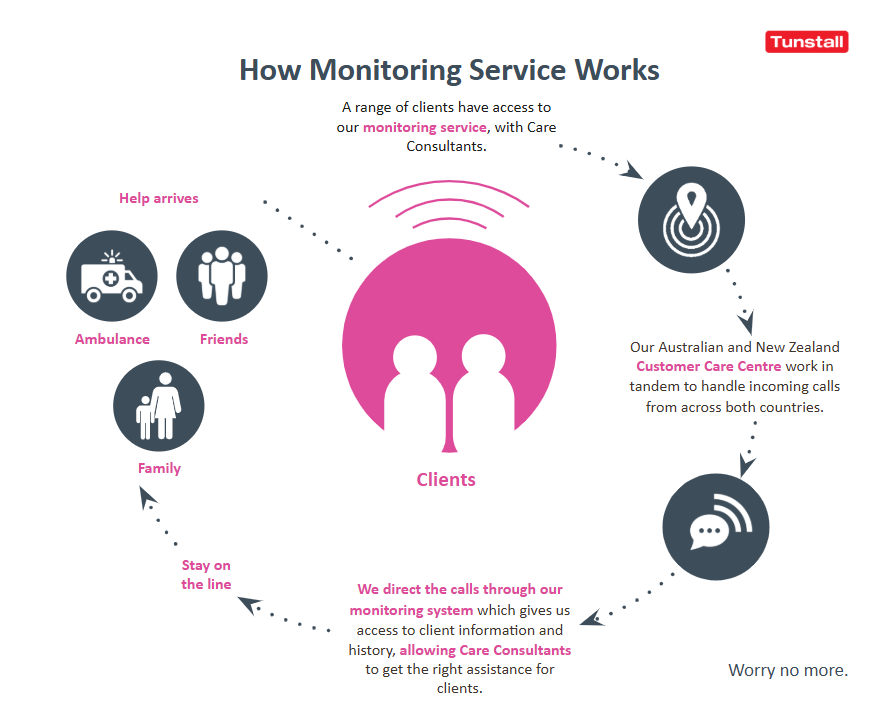
When you press your personal alarm button, you’re immediately connected to our Customer Care Centre, where trained consultants are available 24/7. They’ll assess your situation, coordinate the right response—whether that’s contacting a family member, your carer, or emergency services—and stay with you on the line until help arrives. This means you don’t need to remember emergency numbers or worry about waking family members in the middle of the night. It’s simple, reliable support when you need it most.
For more information, visit our dedicated Monitoring page.
How to Get a Government-Funded Personal Alarm
Government-funded personal alarms help older Australians and people with disabilities maintain independence while ensuring access to support when needed. Various funding options are available depending on your eligibility and the programs accessible in your area. Our Connected Care solutions have supported people to live independently for over 60 years.
We hope this guide has helped clarify your options for accessing government-funded personal alarms. Living independently and safely at home is possible with the right support—and there are programs available to help make that happen. If you’d like to discuss which solution might work best for your situation, our team is here to help. Contact us to learn how we can help you live more safely and independently in your own home.
Feel free to share this article with family, friends, or carers who might find it useful.
Achieve peace of mind, get your personal alarm today: